Our Happy at Home Annual Report 2025-2026

Happy at Home is our Elderly Befriending service which supports older residents in the postcode areas NN1 – NN5.

Our Report can be viewed here

Elderly isolation (and as a direct result vulnerability) has increased  across the UK by 47% since 2014.

Our own Director of Public Health Report states:

Within West Northamptonshire the population of those aged 65 or over is likely to increase by a further 24%, and therefore a System Wide Approach and Initiatives within that are required to support our elderly residents.

Happy at Home continues to receive higher referral rates year on year. Our combined Social Value has been assessed at 531K.

Russell Rolph, the CEO of VIN states:

We all know an elderly neighbour, friend or relative who might need this service. Referral increases prove that Elderly isolation is a real issue, as is access to support when its needed. In an ever-changing digital world, where digital footprints and digital front doors often mean more cost-effective services, we must never forget a generation which are at risk of exclusion, as such exclusion often leads directly to vulnerability. It’s great to see the work that Happy at Home undertake, in addition to the fantastic Social Value provided. More than that though, it’s about the stories: I hope people enjoy the read.

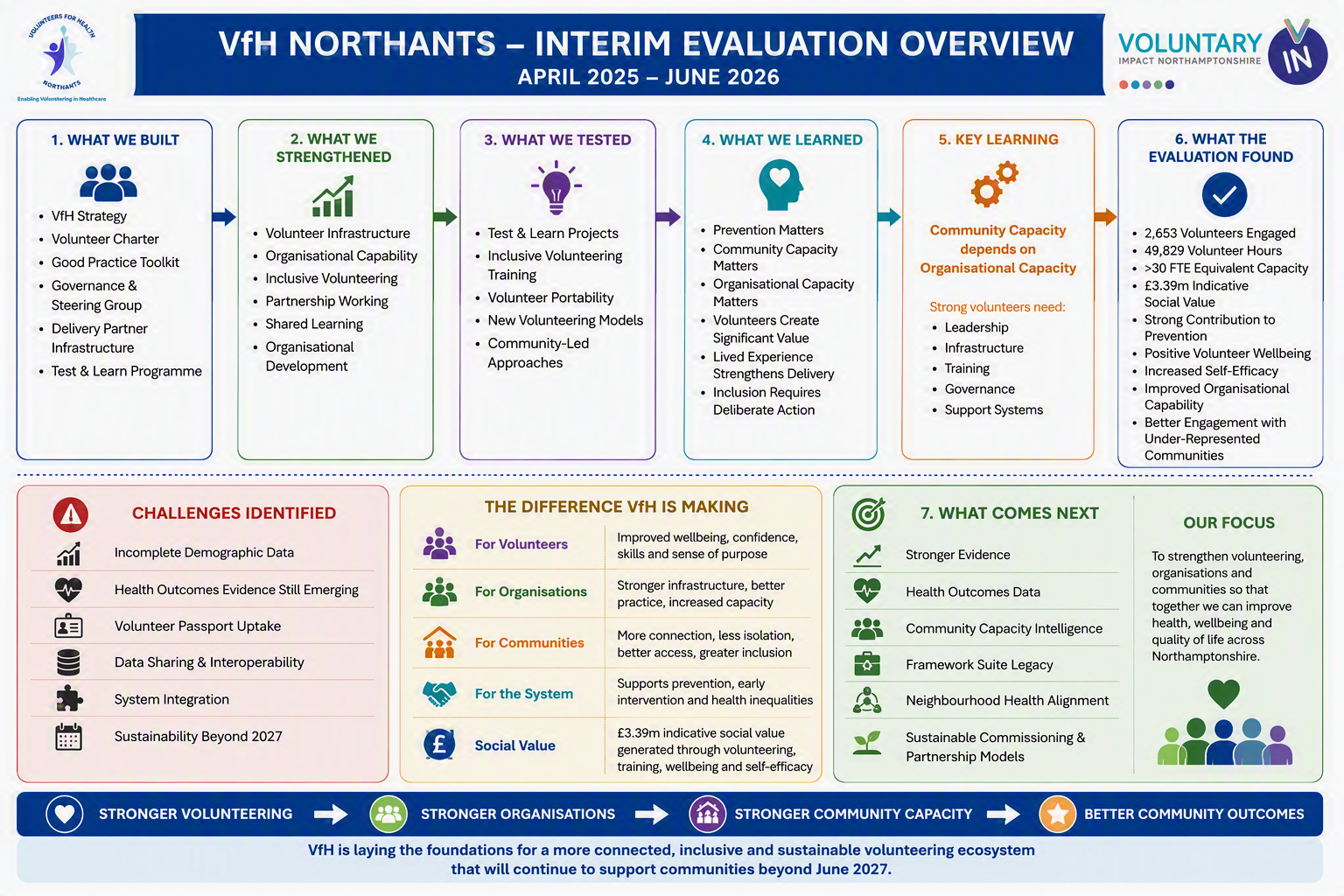
MHNC Inclusive Volunteering Free Training – New Dates Added

NEW DATES ADDED
MHNC are offering free Inclusive Volunteering Training, as part of the Volunteers for Health Northants project.
This training has been co-designed to:
  • Improve the practices of involving and supporting volunteers with mental ill-health, learning disabilities, and/or neurodivergence
  • Challenge unconscious biases about who can and can’t volunteer (spoiler alert: everyone can!)
  • Raise awareness of hidden barriers
  • Provide ideas, tools and resources that can be implemented to ensure volunteering opportunities are more accessible
Through this training, we hope to increase the diversity of people volunteering across Northamptonshire.
If you think this sounds great, book yourself on a session here: https://www.eventbrite.co.uk/o/mental-health-northants-collaboration-70371253553

Feedback from the course: 

So far, 82% of attendees have committed to making changes within their organisation to make volunteering more inclusive, and 100% of attendees have said that they would recommend the training to others.
Attendees have said:
“It was especially powerful that both presenters had ‘real life’ experience.”
“Examples given were a great way to understand & take in the information.”
“The training course was informative and fast paced.”

Discretionary Community Grants – West Northamptonshire

West Northamptonshire Council have issued their latest round of Discretionary Community Grants.

The details can be found here: Fresh grant funding available to power community impact across West Northants | West Northamptonshire Council

These Grants are available to all VCFSE Groups and organisations with a maximum value per Grant of 15K.

All application forms must be submitted by 5pm on Tuesday the 28th of July 2026. 

Cllr Charlie Hastie, Deputy Leader of WNC and Cabinet Member for Housing and Communities states:

Our voluntary and community groups play a vital role in supporting residents and strengthening communities across West Northamptonshire.

They understand local needs and can respond quickly to make a real difference. We’re proud to support their work through this funding and encourage all eligible organisations to apply before the deadline.

The language of Poverty

VIN is reporting on a superb piece written by Northamptonshire’s former ICB chair, Naomi Eisenstadt, who now supports Resolve Poverty.

This piece is about two issues: the language used to describe low-income families, and the way data is sometimes presented about families in poverty. Both the language and the data can lead to discriminatory assumptions about families living in poverty.

For most of my working life I have been engaged in services designed to mitigate the impact of poverty on children. At some point I began to think about balancing policy to reduce the associated risks of growing up in poverty with policy to reduce poverty itself. We can narrow the gap in outcomes for children in low-income families by targeting supplementary education programmes and social welfare activities or we can devise a social security system that reduces the number of children growing up in low-income households. We could and should do both.

Low-income families suffer a double deficit. They live with the inability to provide their children for their basic needs, let alone the luxury of holidays, special birthday treats etc. Secondly, they are stigmatised by the media and some politicians as being the creators of their own difficult situations. The risk of stigma comes when policy makers and the media attach labels to low-income families that are descriptive of behaviours rather than income. In 2017 the DWP stopped referring to income in relation to poverty. It referred specifically to workless households, and the ‘risks’ associated with worklessness. These include family breakdown, substance abuse and debt, all of which can be seen as avoidable behaviours. The relationship between adverse childhood experiences (ACEs) and poor childhood outcomes are well known. The data is clear that poor child outcomes are corelated with increasing numbers of ACEs. Most, but not all children with complex and multiple problems like school exclusion, juvenile crime, and drug abuse, live in low-income families. The converse is not true. Most families on low income are struggling with the challenges of living without enough money to feed, clothe, and pay rent. Most are not involved in crime, drug abuse, or domestic violence. Using the language of disadvantage and vulnerability implies wider difficulties and fails to address the key problem; not enough money. There is an odd shyness about using language that specifies lack of money as the core problem. Even the word money becomes replaced with resources. Language like disadvantage and vulnerability can mean any number of problems including but not exclusively poverty. This narrative gives the impression that most if not all of families in poverty have additional characteristics related to how they live their lives. We offer parents struggling on low-income parenting programmes while the real problems may be not enough cash for the end of the week or the spare cash to fix the broken washing machine.

The presentation of data often reinforces this view. The Families and Children Survey of 2005 found that the risk of being in trouble with the police for teenage boys was ten times higher in families with five or more disadvantages compared to teenage boys in families with one or no disadvantages. The most common disadvantage is poverty itself. Others include family breakdown, parents’ poor mental health, drug and alcohol problems, etc. On reading this one would probably assume that a majority of boys growing up in families with complex problems become young offenders. 1% of boys in families with none or one difficulty become offenders. 10% of boys in families with complex problems get involved in the justice system. 90% of boys, even from families with complex disadvantages, do not have a criminal record. What the data tells us is that while family difficulties increase the chances of teen boys getting into trouble, most teen boys do not wind up with a criminal record. Both these presentations of the data are technically correct. Policy makers and charities will rightly want to attract funding to deal with the problems faced by their beneficiaries. They will present data in ways that tend to emphasize how much greater the risk for the disadvantaged group, rather than the likelihood of the risk itself. This creates strong negative associations with families in poverty. This is old data, but the principle remains.

Narratives about families on low income can be disrespectful and stigmatizing for the majority of low-income families struggling to do the best for the children with rising costs of basic food and housing. As the cost-of-living crisis begins to bite at a wider range of income groups, perhaps the public are becoming more aware of the scaring impact of poverty on adults and children. Most parents, rich or poor, want to do the best for their children. The ability to do the best is made significantly more difficult without a decent income.

Well said Noami..!!

Five-Year Strategic Commissioning Plan

The ICB Cluster of Leicestershire, Northamptonshire and Rutland (LNR) have just released their new 5 Year Plan as they move into the role of Strategic Commissioners.

Their stated Commissioning objectives are:

•  Elective care – improving access and reducing long waits, modernising pathways, reducing unwarranted variation and delivering more care closer to home.

•  Urgent and emergency care – creating a resilient, integrated, and community-focused system that delivers the right care, in the right place, first time, with stronger prevention, same-day care and alternatives to admission.

•  Neighbourhoods – developing a Neighbourhood Health Service, delivered through Integrated Neighbourhood Teams, supported by digital connectivity, shared care records, and population health management.


Alongside these system priorities, The ICB Cluster have identified three strategic transformation ambitions that reflect the most significant population health challenges across LNR:

•  Frailty – enabling people to live a healthy older age with independence and dignity through early identification, proactive and personalised support, and reduced reliance on hospital care.

•  Preventable mortality – preventing early deaths from cardiovascular disease, cancer and respiratory disease through prevention, early diagnosis, and improved long-term condition management.

•  Children and young people’s mental health and neurodiversity – creating a joined-up, needs-led system that enables earlier, more equitable access to support, reduced waiting times and better transitions across the life course. 

The ICB Cluster Plan can be viewed at Page 5.

For those VCFSE organisations interested in Neighbourhood Health and Development this can be viewed at Page 24.

Russell Rolph, the CEO of VIN states:

It is always useful to see the long-term aspirations of our ICB cluster now that it stretches beyond Northamptonshire. VIN, in rotation, has a place at the Cluster Executive and will continue to advocate for our VCFSE. I am interested to see how the ICB Strategic Commissioning role plays out in the world of Neighbourhood Health. For me, there is still much work to be done in involving the VCFSE in health inequalities and health and wealth creation, particularly at a local level where most of our organisations live, work and invest.

VIN launches Managing Change

VIN launchers its new short-term strategy entitled Managing Change.

The Strategy can be found here

Russell Rolph, the CEO of VIN states:

VIN launches its new short-term strategy at a time when the VCFSE is under more pressure than ever. VIN is not immune from these challenges and must find a new way of ensuring the future longevity of Infrastructure Support in West Northamptonshire. For us, it means widening our portfolio of funders and delivering more projects, although we will always look to do this in Partnership with others. Over the next 15 months the concept of Partnership will mean more and must do more. The future of the very VCFSE depends upon those Partnerships working and working well. At the same time, VIN will stay committed to its Core function – advocacy, representation, social action, volunteering, and Group Support. We will further align our priorities and approach with South Northants Volunteer Bureau under the banner of Social Action West Northamptonshire (SAWN) , and as SAWN we need to look beyond West Northamptonshire and build Partnerships in Leicestershire and Rutland.

Lucy Rigby MP visits VIN

Lucy Rigby the MP for Northampton North visited VIN last week to celebrate National Volunteers Week.

Volunteers from VINs Elderly Befriending Project (Happy at Home) and our Car Scheme were in attendance to explain the importance of volunteering and what works well for them.

Lucy was particularly interested in the barriers to increased volunteering, especially amongst young people.

An interesting debate ensued, with contributions form Russell Rolph the CEO of VIN and Rachel Bott, the Centre Director of the Doddridge Centre.

Russell states:

It was great to see Lucy last week. She seemed genuinely interested in the barriers to volunteering and has asked me to provide a position paper on the ways in which volunteering could be increased, particularly around Northampton and its surrounds and especially amongst Young People. I have promised to do this, with a particular emphasis on funding, why the ethos of Volunteering is Free has so much momentum and the message’s that both central and local government should be imparting. I would like to thank all the VIN volunteers that took the time to speak freely and honestly about their experiences. It is appreciated. I would also like to thank Rachel from the Doddridge Centre for contributing, and to Roz (my Happy at Home Co-ordinator) for providing the biscuits and strawberries.

The Big Conversation

West Northamptonshire Council are embarking on the Big Conversation regarding Adult Social Care Provision.

They are reaching out to the VCFSE for support and help in spreading the word.


Why the VCFSE?

As a voluntary or community organisation, you hold trusted relationships with people the local authority may not always reach. You understand their experiences, their strengths, and the barriers they face. That’s why your role is vital in helping the local authority ensure everyone can be heard.


What’s Happening?

West Northamptonshire Council are developing a new plan for adult social care in West Northamptonshire. To shape it, they are launching a survey and a series of “Big Conversation” events across the county. These are safe, welcoming spaces where people can share their thoughts, ideas, and experiences.

How can the VCFSE help?

The VCFSE can:

Area

Chosen Venue

Date

Time

Eventbrite Link

Northampton North & East

Broadmead Community Church, Broadmead Avenue, Northampton, NN3 2QY

29th June

10am – 12pm

https://www.eventbrite.com/e/the-big-conversation-help-us-shape-adult-social-care-in-west-northants-tickets-1990632149345

Northampton Central

Doddridge Centre, 109 St James Road, Northampton, NN5 5LD

29th June

2pm – 4pm

https://www.eventbrite.com/e/the-big-conversation-help-us-shape-adult-social-care-in-west-northants-tickets-1990632340918

Northampton South & West

Duston Community Centre, Pendle Road, Northampton, NN5 6DT

1st July

10am – 12pm

https://www.eventbrite.com/e/the-big-conversation-help-us-shape-adult-social-care-in-west-northants-tickets-1990632426173

Rural North & West

Daventry Leisure Centre, Lodge Road, Daventry, NN11 4FP

2nd July

10am – 12pm

https://www.eventbrite.com/e/the-big-conversation-help-us-shape-adult-social-care-in-west-northants-tickets-1990632479332

Rural South & East

SNVB The Riverside Centre, Islington Road, Towcester, NN12 6AU

2nd July

2pm – 4pm

https://www.eventbrite.com/e/the-big-conversation-help-us-shape-adult-social-care-in-west-northants-tickets-1990632508419

MHLDA Triple Squeeze Report

The Mental Health, Learning Disability and Autism collaborative have produced a Triple Squeeze Report which can be read here

It paints a picture of funding restrictions, increased demand and the pressures faced by charities because of the increase in both the minimum wage and national insurance contributions, legislated in the last Government budget.

Our Northamptonshire VCFSE sector and its challenges mirror the national picture.

From a VIN perspective, the report is a yet another which confirms the perilous state of our sector in these difficult economic times. Ultimately though, it’s not about charities or their structures or people but the beneficiaries they serve. If the sector starts to degrade our communities will be the poorer for it, and out statutory colleges will not be able to fill those gaps.

As for what can be done, well that’s a much trickier conundrum but it starts with Central Government and works through Local Government and Local Funders.

As CEO of VIN, I welcome the debate, not about restrictions or reductions but how better value can be achieved for what’s already committed.

VIN attends Volunteer Fair

On the 2nd of June 2026 VIN staff attended the Volunteer Fair at Weston Favell to mark National Volunteers Week. Around 12 charities were in attendance, and VIN staff spoke to 20 potential volunteers.

NLIVE organised the event and were running their local radio segment on all things volunteering.

Russell Rolph, the VIN CEO states:

It was nice to see so many charities in attendance, generating interest from local shoppers and potential volunteers. Many thanks to NLIVE for organising, and for Weston Favell Shopping Centre for facilitating. It’s great to mark National Volunteers Week. Volunteers are vitally important for the local voluntary sector and bless us with their skills and knowledge. I would encourage any individual to consider volunteering to make new friends, use their skills, and learn something new.

For more information about volunteering please E-Mail VIN on info@voluntaryimpact.org.uk

You can also visit the County Wide Volunteering Platform at: Community Action Northants – Volunteering opportunities in Northamptonshire