Introduction to AI for small charities

Join us for introductory interactive training on how Artificial Intelligence (AI) can help your small charity improve efficiencies, enhance communications and support fundraising efforts.

You’ll learn about opportunities for your small charity or community organisation to use AI creatively and in an informed and safe way. You’ll take part in quizzes, discussions with peers and start using commonly used AI tools and techniques for your everyday work.

You’ll also gain a policy or guidance template you can adapt for your organisation along with further resources to support you to take the next steps in your AI journey.

This course is being developed in partnership with NAVCA, Superhighways, Councils for Voluntary Services in the UK and Voluntary Impact Northamptonshire. By taking part and giving feedback you will be supporting other small organisations to learn more about AI.

VIN AGM and Signed Accounts

VINs Annual General Meeting took place on the 13th of November 2025.

The AGM Presentation can be found here, and VIN would like to thank all the speakers for their contributions:

The AGM Minutes can be found here

VINs Signed Accounts can be found here


Consultation on Draft Active Travel Strategy, Draft Mobility Hub Action Plan and Draft Rail Action Plan

Over the past few months West Northamptonshire Council have been developing a series of supporting strategies following the adoption of the Local Transport Plan in March 2025. These draft documents set the policy and actions for the Council to take over the coming years to implement the infrastructure detailed in the Local Transport Plan. West Northamptonshire Council have brought forward the first three of these draft strategies for public consultation, which have now been published for an 8-week consultation period. The draft documents are:

  1. Draft Active Travel Strategy.
  2. Draft Mobility Hub Action Plan.
  3. Draft Rail Action Plan.

The consultation will be open for responses from the 3rd of December 2025 until the 27th of January 2026, and the documents and consultation forms can be accessed via the Council’s dedicated consultation portal. The link to the consultation is here:


https://westnorthants.citizenspace.com/place/transport-strategy-and-action-plans-consultation/

The Council greatly appreciates the contributions already made by our stakeholders at the in-person events, and through written feedback. Should you have any questions or feedback that you’d like to send to the team, please contact us with our dedicated email address:

LocalTransportPlan@westnorthants.gov.uk

Members of the Highways and Transport Planning Team will be hosting virtual events in early January 2026 for any stakeholders who wish to discuss these supporting strategies directly with the team. Further information on these events will be shared closer to the time.

  VACCINATION

MMR and HPV Vaccinations


Asset Based Community Development

West Northamptonshire have commissioned VIN with a piece of work aligning strongly to the principles of Asset Based Community Development or ABCD.

VIN is now looking for 20 individuals from 20 different organisations who might be interested in joining the programme.

The programme consists of:

  • A 2-day classroom course delivered by Forever Manchester at a Northampton venue. This is an accredited ABCD course.
  • A Community of Practice Meeting with VIN to digest the learning from the course.
  • A bursary of 1K to run a small project which distils the learning and shows trace elements of ABCD.
  • A reflective Community of Practice at Project end.

To be eligible VCSE organisations must be based in West Northamptonshire and must commit to all elements of the programme. Nonattendance will mean removal from the programme. In addition, eligible VCSE organisations must have 1 of the following 3 components:

  • Be undertaking some form of Outreach or Development work.
  • Have a hub which beneficiaries visit.
  • Be working with a specific health inclusion group.

Organisations can submit their interest by E-mailing russell.rolph@voluntaryimpact.org.uk

When E-mailing organisations must identify which LAP area they work in or more if that’s the case.

A list of interested parties will then be forwarded to West Northamptonshire Council for their final decision.

It is envisaged that this programme will commence in late January 2026. All selected organisations will be contacted directly by the VIN CEO.

VIN signs to the International Ethical Recruitment Charter

The International Ethical Recruitment Charter for West Northamptonshire has been launched.

This is a significant achievement which VIN took part in and plays a pivotal role in creating a document that upholds the highest principles of ethical and respectful recruitment for international care workers.

The Charter is now live and available for sign-up on the West Northamptonshire Council website, where care providers can formally commit to its principles.

Explore and share the Charter: https://www.westnorthants.gov.uk/irec

STOPPING SMOKING

Stopping Smoking Information Support and Signposting

Stop Smoking Information

Outcomes Matrix

The Outcomes Matrix is a practical tool to help social impact organisations plan and measure their social impact.


Measuring your Impact.

There is now a requirement amongst funders and commissioners that voluntary and community organisations can provide measurable evidence of the impact or change that the activities they provide make to communities and individuals. Recent years have seen a shift from simply counting inputs and outputs (for example, the number of people using a service) to measuring outcomes (the difference that the service has made to people).

More importantly, measuring impact enables an organisation to monitor and evaluate the social impact their activities are having on people. If someone asked you right now, “What does your project achieve?”, what would you say to them? How do you know how it’s going, what works well, and what doesn’t? Measuring impact enables you to answer these questions knowledgeably.

What do we mean by Impact?

The word impact can be replaced with words like ‘change’, ‘effect’, ‘outcome’, ‘benefit’ and ‘result’, but they all largely mean the same thing.

You’ll hear people talking about demonstrating and measuring impact, which means taking a step back and thinking about the difference you make through the work you do and collecting data to show this.

Your impact may be the difference that you make to those who directly use your service, to those in the local community more generally, or to wider society. The impact you highlight can be wide-ranging and can affect many aspects of people’s lives.

The benefits of measuring impact

Collecting data on the difference your project is making has many benefits:

  • Helps you think through the problem you’re tackling
  • See how you are doing and how you can improve
  • Helps plan what you are going to do next
  • Tell your story and inspire others
  • Attracts further funding and investment
  • Raises awareness in the local community

Impact Practice

These are the activities that you do to focus on your organisation’s impact. These can be simply split into 4 steps:

  1. Plan your impact
  2. Collecting Data
  3. Analysing your data
  4. Using your impact data:

Step 1: Using a Theory of Change to plan your impact

The Theory of Change is a planning tool that encourages you to reflect on your aims and plans, to discuss them with others, and to make them explicit.

A clear, concise, and convincing explanation of what you do and the difference you aim to have is a vital foundation of any organisation’s strategy, evaluation, and communication.

A Theory of Change explains how an organisation has an impact on its beneficiaries. It outlines all the things that a programme does for its beneficiaries, the ultimate impact that it aims to have on them, and all the separate outcomes that lead or contribute to that impact.

A Theory of Change is often represented in diagram form. This can take the form of a Weaver’s Triangle or a Logic Model. It is also possible to do a narrative version of a Theory of Change. It is worthwhile to remember that it is the process of doing a Theory of Change that is important, not the end diagram!

A Theory of Change should not refer to the scale, growth plan, or operational details of the organisation itself. Rather, it should effectively describe and explain the impact of the organisation’s services from a beneficiary’s point of view.

How to create a Theory of Change

The charity New Philanthropy Capital (NPC) produced Theory of Change in 10 steps. This guide is aimed at small organisations that are new to measuring impact and is based on their learning from supporting organisations for many years to develop their Theory of Change.

The blog called 4 Tips to write a good theory of change by Margery Infield from NPC is also worth a quick read, as it advocates that all organisations should try and articulate their Theory of Change in no more than 20 boxes and not over complicate it.

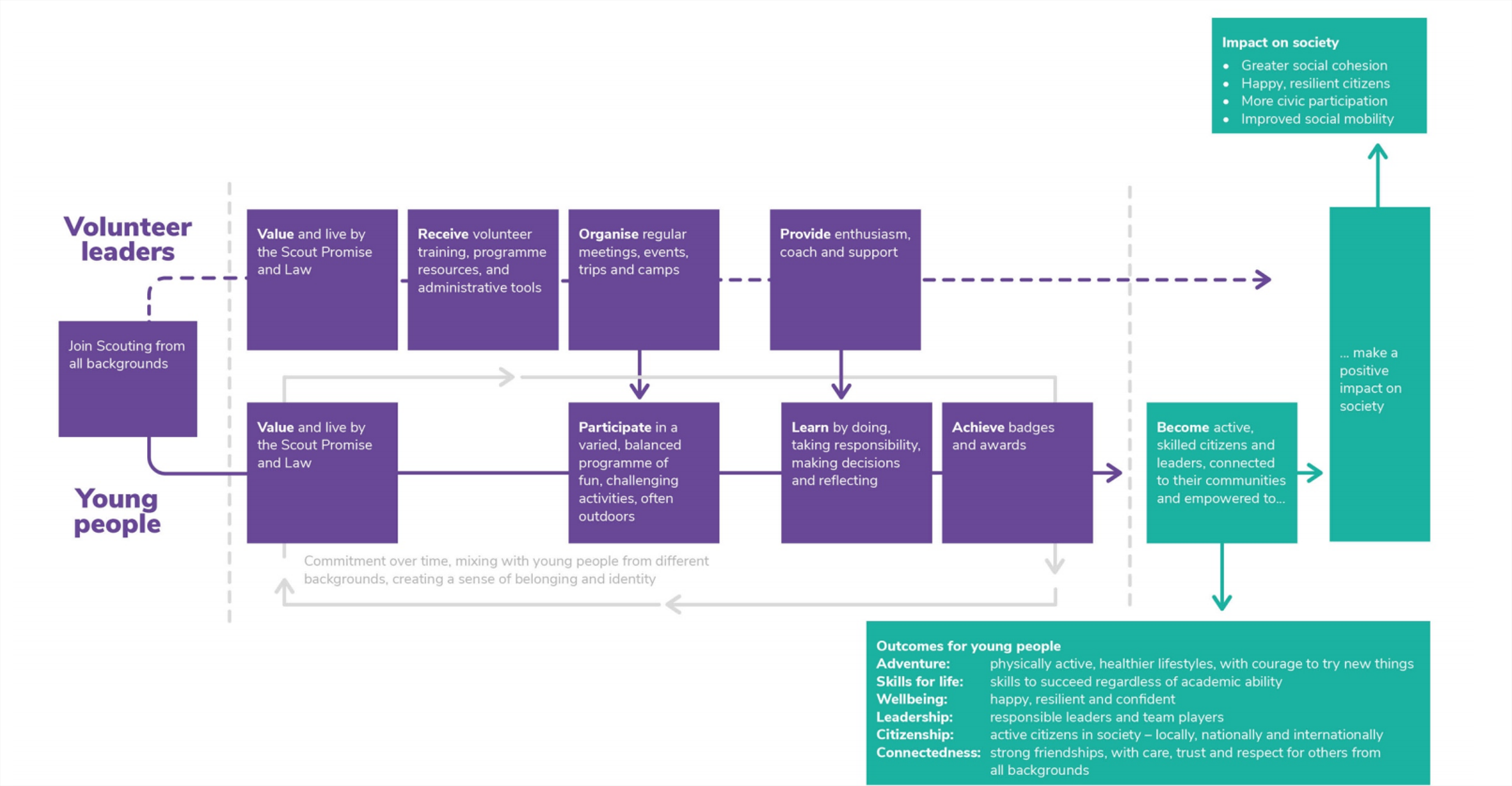
Theory of Change Examples:

Refugee Council– a good example of a one-page Theory of Change poster.

New Horizon Youth Centre a good example of a narrative version

Scouts

Young Enterprise