Our Volunteer Charter

NHFT meets the VCFSE 28th January 2026

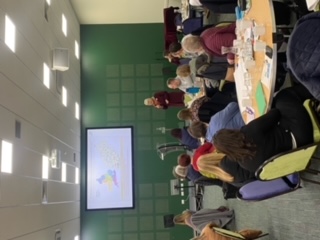
On the 28th  January 2026, Northamptonshire Healthcare NHS Foundation Trust (NHFT) Executive and Operational Directors met with the VCFSE to begin a discussion on how closer connections can be forged around the issue of Neighbourhood health.

The event was organised by SAWN (the Infrastructure Partnership of West Northamptonshire) and chaired by the VCSE Assembly; it set out how  NHFT currently works and where the touchpoints with the VCFSE could be now and in the future.

Our Aspire colleagues from North Northamptonshire were also in attendance.

The Presentations from the session can be downloaded below:

  • NHFT presentation explaining the NHS 10-year plan.
  • Exploring the NHS 10-year plan – this presentation places the VCFSE and NHFT in a county context and explains what “Place” and “Neighbourhood” mean.
  • Mental Health Northants Collaboration (MHNC) presentation – referring to an example of how a collaboration between the VCFSE and NHFT developed.

Table discussions focussed in on how NHFT and the VCFSE could work in a more streamlined, focussed, and effective manner, and what the key priorities for Neighbourhood working should be.

The event was held at Kings Park Conference or Action Centre and was attended by over 60 Individuals.

The table notes for this event will be compiled by VIN in due course and circulated to all attending delegates.

SAWN will be looking to build upon this event with a further West Northamptonshire gathering in Spring 2026.

Russell Rolph, the CEO of VIN, states:

It was great to see NHFT come out in force at Director level to showcase their work. There was a real willingness from NHFT to work with the VCFSE and value them as true partners. I hope we can build upon the momentum we have created and look forward to a further gathering, hopefully around April of 2026. This will be West Northamptonshire-centric as our Infrastructure Partnership (VIN and SNVB) supports over 1660 community organisations across this geographical area. I would like to personally thank all NHFT who made the effort to communicate, engage, and understand in a refreshing inciteful manner.
STOPPING SMOKING

Stopping Smoking Information Support and Signposting

Stop Smoking Information

Northamptonshire Suicide Prevention Strategy

The all-age, county-wide Northamptonshire Suicide Prevention Strategy and Action Plan 2022-2025 is due to come to an end this December 2025. There will be the development of new West Northamptonshire Council’s (WNC) and North Northamptonshire Council’s (NNC) Suicide Prevention and Self-Harm Strategies and Action Plans, with a proposed launch in April 2026.


These Strategies and Action Plans will underpin the county-wide Northamptonshire Suicide Prevention Steering Group.


To support the development of these new documents, a county-wide approach is being taken, led jointly by WNC and NNC Public Health Teams.


During November and December 2025, there will be 4 online workshops (2 hours each), with each workshop focussing on 2 of the national suicide prevention priorities.


The online workshops will allow time to reflect on what has been achieved locally for these priority areas to date and discussion time to explore potential objectives and actions to address future areas of focus. These discussions will need to be aligned with current resource and system to ensure the development of achievable action plans.


The below table highlights the priorities each workshop will focus on:


Workshop  Priorities 
1  Priority 1: Improving data and evidence to ensure that effective, evidence-informed, and timely interventions continue to be developed and adapted.
Priority 3: Addressing common risk factors linked to suicide at a population level to provide early intervention and tailored support.
2  Priority 2: Tailored, targeted support to priority groups, including those at higher risk, to ensure there is bespoke action and that interventions are effective and accessible for everyone.
Priority 5: Providing effective crisis support access sectors for those who reach crisis point.
3  Priority 4: Promoting online safety and responsible media content to reduce harms, improve support and signposting, and provide helpful messages about suicide and self-harm.
Priority 6: Reducing access to means and methods of suicide where this is appropriate and necessary as an intervention to prevent suicides.
4  Priority 7: Providing effective bereavement support to those affected by suicide.
Priority 8: Making suicide everybody’s business so that we can maximise our collective impact and support to prevent suicides.


If you are interested in attending any of the online 4 workshops, please respond to this email by COP Wednesday 15th October 2025 with your name, email address, and the workshops of interest.


You will then be sent the relevant workshop meeting invitations.


Please note that a pre-reading document will be shared ahead of the workshops with essential and recommended reading. This is to ensure attendees have a good understanding of the work area and to help maximise discussion time within the workshops.


NHS transformation – Briefing Summer 2025

Overview

Proposed changes to Integrated Care Board (ICB) functions and geography are being discussed as part of a wider NHS reform programme, to reduce management costs and focus more money on the front line.

All ICBs in England are being asked to significantly reduce running costs and shift to a more strategic role with different responsibilities for them and other parts of the health and care system.

This involves some ICBs working more closely with other ICBs in a cluster.

Clustering means that, although individual ICBs will continue to exist, they will work as one – with a single Board, leadership team, and staffing structure.

NHS England and government ministers approved a new cluster for Leicester, Leicestershire and Rutland ICB and the Northamptonshire ICB. This would be one of 26 clusters across England.


National context


The proposal is part of a wider reform of the NHS operating model across England, which will involve the integration of the Department of Health and Social Care and NHS England, and a changed role for NHS regions, ICBs and providers.

As part of this, NHS England and the Department of Health and Social Care are aiming to create a new, leaner, and simpler way of working in which each part of the NHS is clear on its purpose, what it is accountable for, and to whom.

The aim also is to lay the foundations for longer-term reform to shift resources into prevention, wellbeing, and care closer to people’s homes, as part of the Government’s ambitious 10-Year Health Plan, launched last month.

The plan sets out its vision to guarantee the NHS will be there for all who need it for generations to come.

It has been shaped by the experiences and expectations of members of the public, patients, partners and the health and care workforce across the country, reflecting the changes that people wanted to see.

Through the three shifts from hospital to community, from analogue to digital, and from treatment to prevention you can read the plan on the Government’s website: 10 Year Health Plan for England: fit for the future – GOV.UK


Local Priorities


The absolute priority for the NHS this year is to continue providing high-quality patient care while reducing waits whether that is waits for surgery, ambulances, Emergency Department, or hospital discharge.

A key part of this is boosting neighbourhood health services supporting the national shift towards a more preventative, community-based NHS.

Bringing care closer to people’s homes through integrated neighbourhood teams recognise the complex and interconnected challenges that many patients face.


ICB cluster design


A process is currently underway to design how the new ICB Cluster could work to best meet the needs of the local population within a mandated reduction in organisational running costs.

Draft NHS England guidance on ICBs’ future role and purpose outlines the need for ICBs to build strong strategic commissioning skills to improve population health and reduce inequalities.

Leicester, Leicestershire and Rutland ICB and Northamptonshire ICB are currently looking at what functions should be kept, grown, or reduced – and what might need to transfer elsewhere or to stop altogether.

Design discussions have considered a range of considerations such as population size and needs, patient flows, the need to discharge statutory duties, partnership arrangements and the imperative for maintaining strong ‘place-based’ geography to support development of neighbourhood health in the future.

The priority remains to serve the populations in Leicester, Leicestershire and Rutland and Northamptonshire in the best possible way, working closely with, and remaining accountable to, all local health and care partners.